You know the drill by now.
Every morning, before you even reach for your phone, before the baby stirs, before your husband rolls over, you do it. You run your hand across your stomach under the wrapper. Just checking. Just hoping. Maybe today it will be different.
It is not different.
So you get up, you choose the same loose boubou you have worn to three owambes already this year, and you carry on. Because what else do you do?
You have tried. Nobody can say you have not tried. The waist trainer sat on your belly for fourteen days until it started leaving marks and doing absolutely nothing. You wore it so faithfully, sleeping in it some nights, and yet. Nothing. The shape came back the moment you removed it.
Your mother came for Omugwo and did the hot water and wrapper ritual she swears by. The same ritual that worked for your aunty, your cousin, your neighbour. You did it every single morning for six weeks. Maybe I need to do it longer, you told yourself. You did it longer. Still nothing.
You found a YouTube workout video. Twenty minutes of crunches and sit-ups, three days in a row. On the fourth day there was a strange pulling sensation deep in your abdomen and you stopped immediately. You have not gone back to that channel.
You spent one entire month refusing rice. You know how hard that is. You sat at Sunday lunch watching your husband eat the jollof and told everyone you were watching your diet. Your mother-in-law gave you a look. You know that look. You still did not eat the rice. And after thirty days of that suffering, your stomach looked exactly the same.
Maybe this is just how my body is now. You have said those words. Maybe not out loud. But you have said them.
The worst part is not the belly. You know that, even if it is hard to admit. The worst part is how it shows up everywhere else. The way you angle yourself in photographs. The way you have started avoiding your husband's eyes when he comes close at night. The way your sister asked you last week if you were expecting again and you laughed it off but went to the bathroom immediately after so nobody would see your face.
Your last child is seven months old. Your body has had seven months and it still looks like this. What is wrong with me?
Nothing is wrong with you. Something is wrong with the advice you have been given.
Every solution you have tried was designed for a different problem. A generic weight loss problem. Not a postpartum body problem. Not your specific body, after your specific pregnancies, with your specific meals and your specific life. The waist trainer, the teas, the crunches, the rice embargo, none of those were ever going to work for what is actually happening inside your abdomen. And nobody told you that.
Keep reading. Because what comes next changed everything for me, and I want it to do the same for you.
My name is Adaeze. I am a mother of three, a wellness writer, and for eighteen months after my third pregnancy, I was a woman who had stopped looking in mirrors.
Not dramatically. Not because I hated myself. I want to be honest about this. It was subtler than that. I just stopped seeking out my own reflection. I would brush my teeth staring at the tap. I would dress quickly and leave the room before the thought could land properly. I had learned to navigate my own home in a way that minimised my awareness of my own body.
My third daughter, Amara, arrived fourteen months ago. She is the joy of my life. Her birth was also the beginning of the longest body struggle I have ever quietly carried.
After my first two children, things bounced back. Not perfectly, not quickly, but enough. My body felt like mine again within six or seven months. With Amara it was different from the beginning. The belly that was there at six weeks was still there at twelve weeks. Still there at six months. People stopped asking when I was due, but I could still see the question in their eyes.
My husband never said anything unkind. He is not that kind of man. But I noticed. The way I started making small excuses at night. The way I would turn slightly away when he reached for me. He did not understand why and I did not know how to explain it to him. How do you tell your husband that you feel like a stranger in your own skin?
The breaking point came at my cousin's traditional wedding in Enugu.
I had bought a new ankara for the occasion, something fitted, something that felt like the old Adaeze. I tried it on the morning of the wedding and stood in front of the mirror for a long time. Then I changed into a different outfit. A looser one. And I spent the entire day watching photographs being taken while I arranged myself carefully in every single one.
That evening, looking through the photos on my phone, I saw myself the way I had been trying not to see myself for months. And I sat in the hotel bathroom and cried. Not loudly. My husband was asleep in the next room. Just quietly, by myself, the way mothers learn to do things quietly so they do not worry anyone.
That was when I decided to actually understand what was happening.
I had been treating the symptom. What I needed to understand was the cause.
I had a friend from university, Kemi, who had trained as a physiotherapist and specialised in postpartum recovery. I had been embarrassed to bring it up with her before. That particular shame that makes you not want to admit to people who know you that you are struggling. But after Enugu, I sent her a voice note at midnight.
What she told me on the phone the next day rearranged everything I thought I knew.
She asked me one question first. "Adaeze, did anyone ever check you for diastasis recti after your deliveries?" I said I did not know what that was. She was quiet for a moment and then said, "That is the problem."
Diastasis recti is a separation of the two columns of abdominal muscle that runs down the centre of your belly. It is extremely common after multiple pregnancies, especially close together. It looks like a soft dome or a persistent pouch. It does not respond to diets. It does not respond to crunches. In fact, crunches make it significantly worse. And absolutely no amount of compression from a waist trainer will close it.
Every single thing I had tried was the wrong tool for the actual job.
Kemi walked me through a simple self-test I could do right there on my hotel room floor. Two fingers placed across my navel, a gentle head lift. She counted over the phone from what I described to her. Two to three finger widths of separation. Moderate diastasis recti, probably present after my second pregnancy, widened significantly after my third.
"The good news," she said, "is that this responds really well to the right approach. The bad news is that everything you have been doing has been working against you."
I spent six weeks learning from Kemi. Not intense gym sessions. Not painful regimes. Twenty minutes a day of the right breathing, the right movements, in the right sequence. She explained why the Omugwo method works for the first weeks but needs to be followed by something different. She explained why cutting rice while breastfeeding was actually causing my body to conserve the very fat I was trying to lose. She explained the specific movements that close a separation rather than widen it.
By week four, I noticed my posture changing. By week six, I put on a dress I had not worn in over a year and it sat differently. Not perfectly. Not like before three pregnancies. But differently. Like my body and I had started a conversation again.
By week ten, my husband held me one evening and said, "You seem more like yourself." He did not know what I had been doing. He just noticed the shift.
I spent the next several months pulling everything Kemi taught me into a structure any mother could follow without a physiotherapist on speed dial. I added the nutritional guidance, the cultural specificity for Nigerian foods and schedules, the week-by-week framework, the emotional honesty that most guides completely skip over.
And then I packaged all of it into one place.
This is not a collection of generic tips. It is a sequenced system built specifically for Nigerian and African mothers, grounded in postpartum physiology, designed around the foods you actually eat, and structured to fit inside the real schedule of a woman who is managing a household, a baby, and possibly other children at the same time.
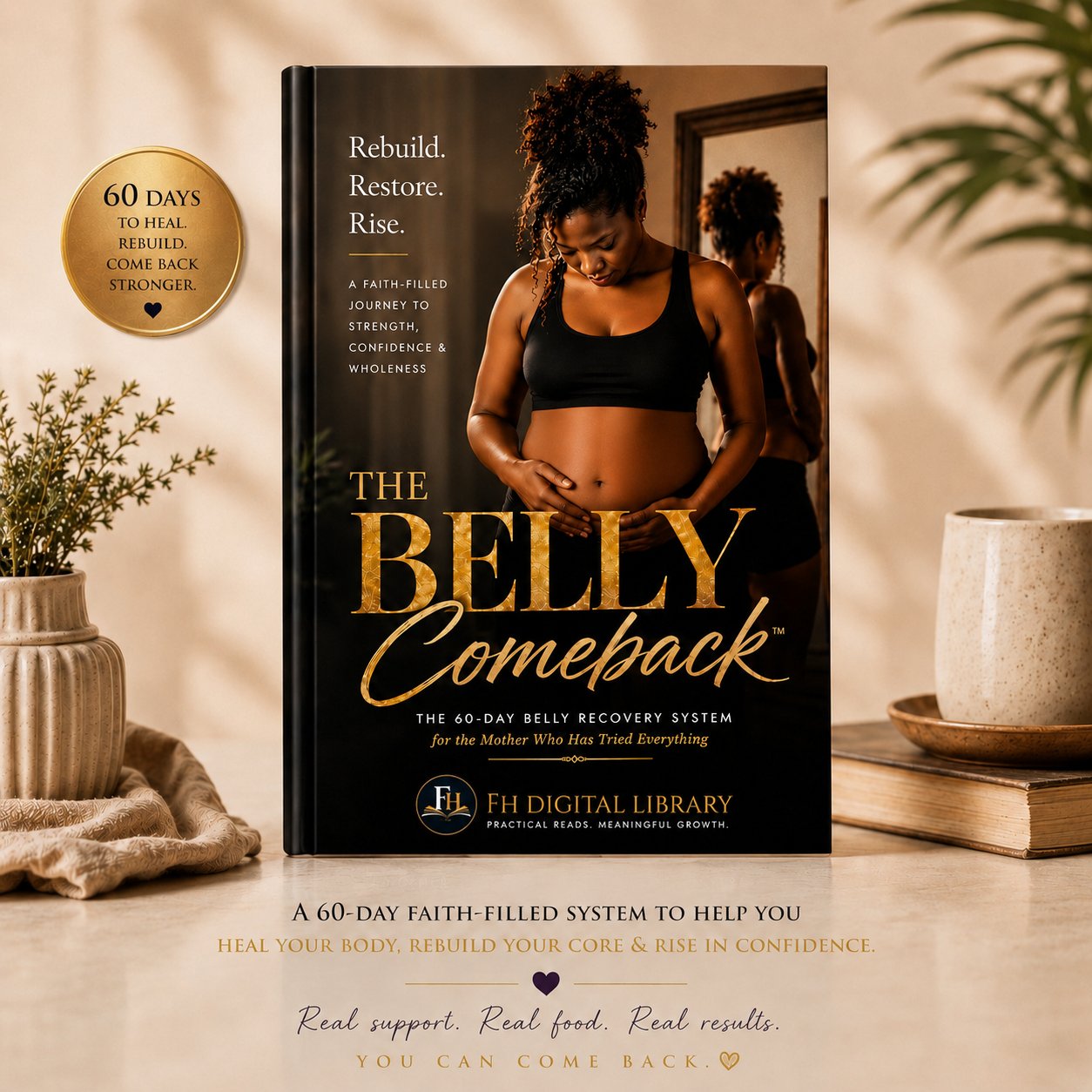
Most mothers spend months treating the wrong problem. Part One gives you a ten-minute self-diagnosis called the Mirror Method™ that tells you exactly which of four distinct belly types you have. Separation Belly, Retained Fat Belly, Deflated Skin Belly, or a Combination. Each type responds to a completely different approach, and knowing which one you are dealing with is the single most important thing you can do before changing anything. This section alone explains why everything you tried before did not work, and it does so gently, without blame.
Before your belly can change on the outside, your core must heal on the inside. Part Two introduces the Core First Formula™, a four-phase sequence that closes the internal gap safely before asking your body to strengthen. You will learn the Three-Breath Pause™, the foundational breathing technique that activates the deepest layer of your abdominal muscles without any equipment or expertise. You will also find the Nigerian food guidance here, specific, practical, and built around pounded yam, ugwu, stockfish, and the actual meals your household eats every day, not a Western grocery list that has nothing to do with your life.
Twenty minutes per day. Five days per week. The Daily Twenty™ is the complete movement sequence you follow across all sixty days, broken into three phases that progress as your body heals. Phase One covers Days 1 to 7 and involves no traditional exercise at all. Phase Two introduces gentle core connection work from Days 8 to 25. Phase Three builds progressive strength from Day 26 onward. Every movement in every phase is safe for all four belly types, including Separation Belly, and every phase includes specific guidance for mothers who delivered by C-section. Nothing is assumed. Everything is explained.
This is the practical heart of the guide. Eight weeks laid out clearly, with a weekly focus, a daily checklist, and a short reflection at the end of each week so you can notice your own progress rather than only measuring it in the mirror. The week-by-week structure removes the decision fatigue that kills most recovery attempts. You do not need to think about what to do today. You open the guide, find your week, and follow the plan. It was designed to be picked up on the worst days as much as the good ones.
No other postpartum guide talks about this part, and it is the part many mothers need most. Part Five addresses the emotional cost of postpartum body changes directly and honestly. The mirror avoidance. The husband's touch you have been deflecting. The photographs you are not in. The invitations you have declined. This section does not offer empty positivity. It gives you the specific mindset tools, the Comeback Manifesto™ and the daily self-language practices, that help you start feeling at home in your body before it has fully changed. Because confidence does not arrive at the destination. It grows on the walk there.
Included at the back of every copy: the Nigerian Food Swap Guide showing exactly how to adjust the meals you already cook for maximum recovery, the Binder and Waist Trainer Protocol explaining the right and wrong way to use compression garments depending on your belly type, the 60-Day Progress Tracker so you can measure what the mirror cannot always show you, and the Daily Checklist you can print or screenshot for your phone. These are not afterthoughts. They are the practical infrastructure that makes the guide actually usable in daily life.
Here is what almost no postpartum advice gets right. The postpartum belly is not a fitness problem. It is a structural recovery problem that has a fitness component, in that order. Structure first. Fitness second. Every approach that reverses this sequence, and nearly every approach out there does, produces temporary results at best and actual damage at worst.
The Hidden Core Gap™ is the real mechanism behind a persistent postpartum belly. During pregnancy, especially multiple pregnancies close together, the linea alba, the connective tissue that runs down the centre of your abdomen, is stretched beyond its resting length. When it does not return to its original position after delivery, it leaves a structural gap. Everything you do on the surface, wrapping, compressing, crunching, burns calories around this gap without addressing it. The belly reshapes temporarily and then returns, because the underlying structure has not changed.
The Core First Formula™ closes this gap by working in the correct sequence. Breath activation first, which reconnects the diaphragm and pelvic floor to the deep core. Gentle connection work second, which begins closing the separation with controlled internal pressure. Progressive strengthening third, once the structure has been restored enough to handle external load. Integration fourth, once the recovery has become the new normal.
This is the same sequence used by postpartum physiotherapists globally. It is the reason sports medicine and postpartum rehabilitation consistently produce results that generic weight loss advice cannot touch. The Belly Comeback™ delivers that sequence in a format any mother can follow at home, in twenty minutes a day, with no equipment, no gym membership, and no prior knowledge of anatomy.
The Nigerian food guidance works because it removes the single most common nutritional mistake postpartum mothers make, calorie restriction while breastfeeding, and replaces it with strategic timing and specific additions that support hormonal fat release rather than triggering hormonal fat storage. You do not eat less. You eat smarter, and you eat the same foods.
I want to be transparent about this, not to impress you, but because I think you deserve to know what went into the resource you are considering. This was not an afternoon project. This took months of research, consultation, testing, and refinement before I felt it was ready to put in a mother's hands.
| Medical and Postpartum Physiology Research | ₦45,000 |
| Professional Writing and Content Development | ₦60,000 |
| Editing, Proofreading, and Fact-Checking | ₦25,000 |
| Beta Testing with Real Postpartum Mothers | ₦35,000 |
| Design, Formatting, and Production | ₦35,000 |
| Total Investment | ₦200,000+ |
That is what it cost to build. I am not charging you anywhere near that. Keep reading to see what you will pay today.
Every copy of The Belly Comeback™ comes with two additional resources at no extra cost. These are not fillers. They are the practical tools that make the guide work faster.
Go through The Belly Comeback™. Follow the Daily Twenty™. Read the sections that were written specifically for your situation. If at the end of it you genuinely feel that this guide was not worth every naira you spent, reach out to me directly and I will refund you completely, no questions asked, no paperwork, no awkwardness. I am not worried about this because I know what this guide does when it is actually used. But I want you to feel completely safe making this decision.
Every mother reading this arrives at this same moment. And the path you take from here makes all the difference.
Your body created life. It adapted through nine months of extraordinary change. It is still capable of a comeback. It simply needs the right map.
This is the map.